Web Site Building
Data Collection Solutions by Pace Logic
Deal Island - Chance Lions Club
For a number of years webauthority.net provided services for creating and implementing web sites on the internet. Later the site evolved into a Data Collection Solutions website sponsered by Pace Logic offering customers innovative solutions to meet today’s business needs. The third iteration of the site was for the Deal Island - Chance Lions Club whose major focus was on fund raising activities.
Consequently this site is a great example of what frequently happens when a domain's registration is not renewed and a new owner takes over the site and rebrands it with a new mission. Somes times a new owner has chosen a particular domain to buy because the site's url comports with their vision / theme of what they envision of their newly acquired site. Other buyers of domains want them because the domain had had great traffic and they think the visitors will continue to come to the site even though the new owners may be selling / hawking something that has nothing to do with the site's original purpose or its url.
One has to wonder why the Deal Island - Chance Lions Club used this domain www.webauthority.net for their site. What does Deal Island - Chance Lions Club have to do with web authority? How can visitors even remember the website for Deal Island - Chance Lions Club with an url (webauthority.net) like that.
Fortunately Deal Island - Chance Lions Club current website makes more sense. [Our editor thought this was the ideal time to bring up the philosophers' concept of "nothing" as a way of segmenting into the absurd. But we talked him out of it since we believe we have made sense of these seeming unrelated issues. The "nothing" argument notwithstanding.
1st Iteration of Site circa 2001

Got an idea for a Web Site? ... we can help... webauthority.net provides services for creating and implementing your web site on the internet. We will assist in the process of establishing an internet presence for small and medium size businesses. The experts estimate that sales of products and services via the internet will reach 1.5 trillion dollars by 2002. How much of the pie will your business get? Why do you need a Web Site? Here are just a few reasons why individuals and businesses are selecting the internet as a way to market and promote their products and services.
What about e.commerce? Electronic commerce is a method for effectively selling products and services via the internet. Some of the benefits include:
How to get started ... Fill out the on-line survey. By answering these questions you will have taken the first step toward identifying your needs. |

"In 2002 we filled out the online form and were rewarded with a significant amount of valuable recommendations for our existing business in New York City. We're a small service business trying to get traction in the search results of Google - our primary search term was "local carpet cleaner in NYC" and there was a lot of competition. The other carpet/rug cleaning companies were more established and all already had an established customer base, so we needed to find a way to improve our visibility online. Based on the suggestions we received, we created compelling content that laid out exactly how we were able to out perform our competition. We focused on customer needs - for example, we learned that service businesses like our were often judged based on how quickly they could service customers, so we focused on same day rug cleaning. We also found ways to diversify into related fields - drapery cleaning, rug and carpet restoration, etc. In short, the advice we received was instrumental in our eventual success and we are indebted to the webauthority.net for the support we received." Jon Suiter
2nd Iteration of Site circa 2003

Welcome to Web Authority .... Sponsored by Pace Logic
Data Collection Solutions That Work!
Our mission at Pacelogic is to provide cost effective solutions for data collection and tracking. We offer turn-key solutions for Inventory Tracking, Stockroom Management, Asset Tracking, GPS Vehicle Tracking, and Warehouse Management.
Manage and Monitor your fleet of vehicles using our low cost GPS Vehicle Tracking System from GeoTab.
Pacelogic is a premier provider of turn-key application software from IntelliTrack .
For many implementations, our customization services can provide a solution using a shrink-wrapped software package without breaking the budget.
Pacelogic can provide a total turn-key solution including hardware from manufactures such as Symbol, PSC, Intermec, and Zebra with equipment ranging from wireless LANS to barcode printers.
Pace Logic is dedicated to offering our customers innovative solutions to meet today’s business needs.
-
Integration of PDA devices and hardened data collection terminals to your business systems.
-
Information dissemination using Kiosk applications.
-
Custom written data collection applications
Perhaps the most exciting options include our Kiosk Solutions.
Kiosks provide an amazing number of options for delivering products and services to an increasingly computer literate customer. The Self-Service nature of the well designed kiosk application, allows your customers to benefit from offerings without having to wait for a salesperson or customer service representative – 24 hours a day, 365 days a year.
Because of these benefits, Kiosks are becoming more popular than ever before. Current technology allows kiosks to be connected to central databases via LAN, wireless, or Internet infrastructures, providing instant and timely information.
Our Unique CUSTOMIZE YOURSELF design allows our Kiosk clients to update and modify Kiosk screen content through an easy to use interface. Screen colors, pictures, headings, and other content can be changed in a configuration file and automatically update the display on all kiosks on the network – instantly!
Contact us today to see how this exciting technology can augment your existing sales and customer service offerings.
3rd Iteration of Site

Deal Island - Chance Lions Club
"Striving for Excellence From Our Hearts"
Post Office Box 158
Deal Island, Maryland 21821
I AM A LION...
I was born in 1917. The International Charter is my birth certificate; the blood lines of the world run through my veins. I am many things and many people.
I remember communities where service to one’s fellowman was unknown; when the challenge came, I answered in community after community until today I am over 43,000 clubs. I am over 1.4 million living souls and the ghosts of thousands who have lived and died for me. I am big; I sprawl to all corners of the world; 185 nations and geographic locations embrace my banner.
I am parts of the world throbbing with industry; I represent farms, forests, mountains and deserts; I am in quiet villages and cities that never sleep; you can look at me and see the Golden Rule. You can see me in the lights of Christmas and appreciate my holiday baskets for the needy; I am a leader dog; a pair of glasses or an operation for the near blind… Sight conservation is uppermost in my mind
I am greatly interested in the schools and colleges in this great nation of yours and mine; in the many churches where my people worship God as they think best; I am a ballot box, the roar of a crowd in a stadium and the voice of a choir in a Cathedral; I am an editorial in a newspaper and a letter to a Congressman, because….
My slogan is: Liberty, Intelligence and Our Nation’s Safety.
Yes I am a Lion, and these things that I am; I was conceived in Freedom and God willing, in Freedom I will spend the rest of my days.
May I possess always the integrity, the courage, and the strength to keep Lionism unshackled, to remain a citadel of freedom, of service, and a beacon of hope to all parts of the world for my motto is: WE SERVE
The International Association of Lions Clubs was created in 1917 by a Chicago businessman named Melvin Jones. The International Association of Lions Clubs is today the largest service organization in the world with over 1.4 million members in more than 43,000 clubs in 701 Districts covering 182 countries and geographic areas. Lions Clubs are not social clubs, although there are social benefits to membership. Lions Club members give their time, skills and resources to raise funds for charity giving both in their communities and internationally.
The major focus of Lions fund raising activities is sight conservation, although other projects are pursued such as drug awareness programs in high schools, diabetes awareness programs and other programs that are specific to individual Clubs and Districts. Lions took up sight conservation as their major goal after a speech given by Helen Keller at the Lions International Convention held at Cedar Point, Ohio, in 1925. At that time, Helen Keller challenged the Lions to become "Knights of the Blind", a challenge that has become a rallying cry for Lions projects around the world.
Lions work in the area of sight conservation is carried out at many levels. Individual Clubs sponsor free eye screening programs using mobile eye clinics. In many countries, Clubs sponsor eye surgery camps where cataract surgeries are performed at no charge for those that can't afford this medical care. Many clubs collect old eye glasses for distribution to the needy in other countries.
The International Association of Lions Clubs is the largest non-governmental organization associated with the United Nations and was called upon by the United Nations and the World Health Organization to raise funds for an international program of sight conservation. It has been estimated that 40 million cases of curable and preventable blindness exist on this planet today. Without intervention, this is projected to become 80 million by the end of the decade. The International Association of Lions Clubs began a program of fund raising that they called "Campaign Sight First" in order to cure/prevent 40 million cases of blindness worldwide. Over $148,600,000 has been raised by Lions all over the world for this program. Eye hospitals are being built in the places that most need them. In India alone, over 300,000 cataract surgeries have been performed and that number is rapidly growing. Lions services to humanity range from purchasing eyeglasses for a child who's parents can't afford them to multimillion dollar programs to cure blindness on a worldwide scale.
The Lions Club relies on the generosity of the general public to raise funds for our charity projects. By purchasing products from this page, you help our club raise money to help people. Many people are wary of shopping on the internet, if you have questions about how it works, click Frequently Asked Questions.
Frequently Asked Questions
If I click on one of the books am I required to buy it?
No. When you click on the picture of the book, a new window will open up that links you to the Amazon.com web site. Once at the site, you can browse around till your hearts content without having to order anything.
Thank you for your patronage.
|
|
Beautiful Swimmers : Watermen, Crabs and the Chesapeake Bay by William W. Warner An absolutely fascinating work. A joy to read. Warner captures something about man and nature that is just beautiful. I enjoyed reading it the year it was published and treasure that I have a hard bound copy and a (badly weathered) soft copy, which have both been read several times. Anyone interested in the Chesapeake, Maryland, crabs, watermen, nature, a different way of life, should read this book. |
|
|
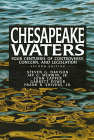
Chesapeake Waters : Four Centuries of Controversy, Concern, and Legislation by Steven G. Davison Chesapeake Waters chronicles four centuries of public attitudes about the Bay - and legislative responses to them - from 1607, the date of the first English settlement in Jamestown, Virginia, to the close of the twentieth century. In the last few decades, wide-reaching measures by federal and local governments have influenced how people use the Bay: the U.S. Environmental Protection Agency completed a massive study of Bay quality; the Chesapeake Bay Program was launched; the Critical Area Protection Act went into effect. The authors make sense of these complex programs, place them in historical context, and explain how they have improved the quality of Bay waters. Chesapeake Waters is as much about the power of public perception as it is about efforts to oversee Bay water quality. In a work rich with anecdotes and historical art and photos, the authors relate how human attitudes and ideas have shaped four hundred years of decisions about the Chesapeake Bay |
 |
Chesapeake Bay Cooking With John Shields : The Companion Cookbook to the Public Television Show by John Shields If you think Chesapeake Bay cooking is all about the hard- or soft-shelled blue crab--about crab cakes, deviled crab, crab soufflés, crab-stuffed mushroom caps, ham and crab imperial, crabmeat curry, crab fluffs, crab and artichoke dip, crab loaf, crab quiche, and soft-shell crab sandwiches--you have another think coming. This isn't to say that the first 60 or so pages of Chesapeake Bay Cooking aren't dedicated to the blue crab. They are. But then John Shields moves right into oysters, then seafood, soups and stews, chicken and game birds, meat and game, and on all the way to desserts, pickles, and preserves. |


49TH ANNUAL SKIPJACK RACE & LAND FESTIVAL
SCHEDULE OF EVENTS – LABOR DAY WEEKEND-2008
SUNDAY: AUGUST 31
1:00 pm. – PARADE (Deal Island School to Festival Grounds)
CAR SHOW-AFTER PARADE: Antiques/Classics/Street Rods
2:00-6:00 pm. – TWO KAYAK RACES
2:00-6:00 pm. – MUSIC ON STAGE::
7:00 pm. – BAND & DANCE:
ARTS/CRAFTS/FOOD/GAMES – ALL DAY
MONDAY: SEPTEMBER 1 – LABOR DAY
SUNRISE – 7th ANNUAL STAN YASTRZEMSKI MEMORIAL FISHING TOURNAMENT (UNTIL 2pm)
8:00 am. – BLESSING OF THE FLEET
9:00 am. – PHRF RACE (Preferred Handicap Race Factor)
9:30 am. – HISTORICAL COMMERCIAL OYSTER FLEET SKIPJACK RACE
10:00 am. – DJ MUSIC
1:00pm – ROLAND PARKINSON MEMORIAL SWIM RACES
1:30 pm –- CRAB POT TOSSING CONTEST (Male/Female Contest)
2:30 pm.–SMALL/TEAM&LARGE BOAT DOCKING CONTESTS
2:00-6:00 pm.- MUSIC ON STAGE:
6 pm.–AWARDS CEREMONY/25 CASH RAFFLE DRAWINGS BY MISS SKIPJACK
ARTS/CRAFTS/FOOD/GAMES -ALL DAY
+++
The 40th Annual Skipjack Race & Land Festival
Saturday ~ September 4, 1999
Starting at 10:00 AM - Thrill to the Roller Coaster, Ferris Wheel, Merry Mixer, Octopus and so much more....................
Beginning at 6:00 PM ..... A Gospel Concert Featuring:
Our very own talented BENTON family AND The Reunion's
And, from Dahlonega Georgia, one of gospel's premier and nationally known family group, The PERRYS.
Sunday ~ September 5, 1999
Beginning at 1:00 PM
A Parade Rides for kids of all ages Arts & Crafts
Food, Soft Drinks, Cotton Candy and so much more
Including Jeff Gordon's Race Car Driving Simulator
2:30 PM ~ Parade Awards Ceremony
3:00 PM ~ Kayak Demonstration And Fly Fishing Demonstration
4:30 PM ~ Smith Island Skiff Race
8:00 PM to Midnight ~ Enjoy dancing and good listening from the popular "Southern Breeze Band."
Monday ~ September 6, 1999
6:00 AM till 3:00 PM ~ Fishing Contest
8:45 AM ~ Little Skipjack Race
9:00 AM ~ Rides and Concessions
9:00 AM ~ Sail Boat Racing, two classes
9:30 AM ~ The 40th Annual Historical Skipjack Race
10:00 AM till 6:00 PM ~ Jeff Gordon's Race Car Driving Simulator
1:00 PM ~ Swimming Contest
2:30 PM ~ Small & Large Boat Docking Contest
6:00 PM ~ Awards Ceremony
Sponsored by the Deal Island - Chance Lions Club
"Striving for Excellence from our Hearts"

More Background On WebAuthority.net
WebAuthority.net is an unusual example of how a single Internet domain can acquire several distinct identities over the course of its life. Rather than remaining associated with one company or subject, the domain was used for at least three markedly different purposes: first as a website-development and Internet marketing service, later as a showcase for business data-collection solutions associated with Pace Logic, and eventually as an online home for the Deal Island–Chance Lions Club on Maryland’s Eastern Shore.
Those changes make WebAuthority.net interesting for reasons that go beyond the individual organizations that occupied it. Its history mirrors broader changes on the Internet itself. Its earliest incarnation belongs to the period when small businesses were still being persuaded that they needed websites. Its second phase reflects the growth of mobile computing, barcodes, GPS tracking, wireless networks, inventory systems and self-service kiosks. Its third phase demonstrates another important use of the early web: giving local civic organizations an inexpensive way to publicize community activities, preserve local history and promote fundraising events.
Today, WebAuthority.net functions primarily as a historical presentation of these earlier uses. Rather than representing a single uninterrupted business, the domain is best understood as a digital address that accumulated several layers of Internet history.
The First WebAuthority.net: Helping Businesses Get Online
The earliest identifiable version of WebAuthority.net dates to approximately the beginning of the 2000s, when simply establishing an Internet presence was still a major step for many small and medium-sized businesses.
The site's message was straightforward: if a business had an idea for a website, WebAuthority.net could help turn it into an online presence.
Its services were described broadly as creating and implementing websites on the Internet and assisting small and medium-sized businesses through the process of establishing themselves online. The site's promotional material reflected the expectations of the dot-com era, emphasizing the enormous projected growth of Internet commerce and encouraging businesses to obtain a share of that developing market.
This is an important historical detail. In the early 2000s, a website was not yet considered as universally necessary for a local business as it is today. Many businesses depended almost entirely on Yellow Pages listings, newspaper advertising, direct mail, radio, storefront visibility and word-of-mouth referrals.
WebAuthority.net therefore had to answer a question that would sound strange to many businesses today: Why do you need a website?
The site explained that an Internet presence allowed prospective customers to learn about a company's products and services, gave businesses additional credibility, expanded their potential geographical market and could allow companies to sell beyond their immediate communities.
The language captures an important moment in Internet history. Web design companies were not simply competing to build better websites; they were still selling the concept of having a website at all.
E-Commerce and the Early Internet Business Model
WebAuthority.net also promoted electronic commerce.
The early site described e-commerce as a means of selling products and services through the Internet and identified potential advantages such as reaching large numbers of customers, reducing inventory requirements, eliminating some of the expenses associated with physical retail locations and potentially reducing staffing requirements.
Visitors interested in developing a site were encouraged to complete an online survey intended to help identify their needs.
That approach illustrates how early web-development firms frequently operated. Instead of today's automated website builders, hosted storefront systems and standardized content-management platforms, a prospective customer often contacted a web designer or consultant who evaluated the business and developed a customized plan.
One testimonial preserved with the site's historical material describes a New York service business seeking greater visibility for competitive local search terms. The account discusses creating useful content around customer needs, same-day service and related services. Whether considered as a contemporary testimonial or historical marketing material, it is notable because it anticipates ideas that later became central to local search optimization: understanding search intent, developing service-specific content and differentiating a business from competitors.
WebAuthority.net's first incarnation can therefore be viewed as part web-design service and part early Internet-business consultancy.
The Transformation Into a Pace Logic Technology Site
By approximately 2003, WebAuthority.net had changed dramatically.
The site now welcomed visitors to "Web Authority" as a website sponsored by Pace Logic. Instead of concentrating on website development, it promoted "Data Collection Solutions That Work."
The audience had also changed. This version of the site was directed primarily toward organizations that needed operational technology rather than businesses merely seeking an Internet presence.
Pace Logic described its mission as providing cost-effective data-collection and tracking solutions. The services represented on WebAuthority.net included inventory tracking, stockroom management, asset tracking, GPS vehicle tracking and warehouse management.
These were practical business systems intended to connect information technology with physical operations.
For example, inventory and warehouse applications could help companies determine where goods were located and how stock was moving. Asset-tracking systems could help organizations maintain control over equipment. GPS technology could allow fleet operators to monitor vehicles. Barcode hardware could speed data entry and reduce manual recordkeeping.
The site's evolution from web design into data collection reflects the rapid expansion of business computing during the early 2000s.
GPS Tracking, Barcodes and Mobile Data Collection
One of the technologies specifically promoted through the Pace Logic incarnation of WebAuthority.net was GPS vehicle tracking.
The site advertised a GeoTab-based system for managing and monitoring fleets. GeoTab—now generally styled Geotab—subsequently became a major name in fleet telematics, making the historical reference particularly interesting. Modern telematics platforms combine GPS positioning with vehicle, engine and operational data, but in the early 2000s the ability to economically monitor business vehicles represented a comparatively new opportunity for many small and midsized fleets.
WebAuthority.net also identified IntelliTrack application software and hardware from manufacturers including Symbol, PSC, Intermec and Zebra.
The range of products illustrates the type of environment Pace Logic was addressing: warehouses, stockrooms, distribution operations and other businesses in which employees needed to collect information away from a traditional desktop computer.
The website promoted integration of PDA devices and hardened data-collection terminals with business systems. That terminology strongly dates the site to its era. PDAs—personal digital assistants—were important mobile business tools before smartphones absorbed most of their functions, while rugged handheld terminals became commonplace in warehousing, transportation, retail and logistics.
Pace Logic's proposition was not simply to sell hardware. It presented itself as capable of combining software, customization and equipment into turnkey systems.
The Kiosk Business
Another prominent element of the Pace Logic version of WebAuthority.net was kiosk technology.
The site presented kiosks as an increasingly important way to provide products, information and services to computer-literate customers without requiring continuous assistance from a salesperson or customer-service employee.
It emphasized the ability of kiosks to operate around the clock and to connect to central databases using local networks, wireless systems or Internet infrastructure.
One particularly interesting feature was described as a "CUSTOMIZE YOURSELF" design. Clients could modify elements such as screen colors, photographs, headings and other content through configuration files, with the changes then distributed to kiosks on a network.
Today this sounds routine because remotely managed digital displays, touchscreens and cloud-connected devices are common. At the time, however, centralized content management for distributed kiosks represented a practical application of technologies that were only beginning to become commonplace.
This portion of WebAuthority.net consequently provides a snapshot of an intermediate period in business computing—after networked databases had become established, but before smartphones, tablets and cloud-based software transformed how businesses and customers interacted with information.
A Third Life: The Deal Island–Chance Lions Club
WebAuthority.net eventually underwent an even more surprising transformation.
The domain became associated with the Deal Island–Chance Lions Club in Somerset County, Maryland. This had essentially nothing to do with the "Web Authority" name, web design or Pace Logic's data-collection business.
The mismatch between domain name and organization is one of the most distinctive features of WebAuthority.net's history. A visitor encountering the address without context would have had little reason to expect a Lions Club serving Chesapeake Bay communities.
Nevertheless, WebAuthority.net became a useful online resource for the organization, carrying information about Lions activities, fundraising and one of Deal Island's best-known traditions: the annual Skipjack Race and Festival.
Independent online references confirm that WebAuthority.net was being promoted as a source of information for the Deal Island–Chance Lions Club's Skipjack festivities as late as 2011.
The Deal Island–Chance Lions Club
The Deal Island–Chance Lions Club has a history extending well beyond its association with WebAuthority.net.
The club traces its beginnings to 1952. Historical Lions records credit the Princess Anne Lions Club with sponsoring the new organization. Clyde A. Bayless became its first president, and the club quickly became involved in practical community projects.
Its early accomplishments reportedly included providing eyeglasses and eye examinations, helping organize the local fire company, assisting efforts to obtain a physician for the community, establishing a scholarship fund and supporting residents in need.
That community role is particularly significant because Deal Island and Chance are relatively small communities on Maryland's lower Eastern Shore. In places without the institutional infrastructure of a large city, civic organizations can have an unusually visible influence on community life.
The club's modern website continues that service-oriented tradition. Its activities include scholarships, community events and partnerships with local organizations.
The Skipjack Race and Festival
The most culturally significant material associated with the Lions Club phase of WebAuthority.net concerns the Deal Island Skipjack Race and Festival.
Skipjacks are traditional Chesapeake Bay sailing vessels closely associated with Maryland's oyster industry. Their broad decks, shallow draft and large sail plans made them particularly suited to dredging oysters from the Bay.
By the middle of the twentieth century, however, the working skipjack fleet had declined dramatically.
According to the Deal Island–Chance Lions Club's history of the event, the idea of reviving skipjack racing developed in 1959 when local captains and Lions discussed the old workboat races. The Lions Club subsequently sponsored a new race, and in 1960 sixteen skipjacks participated. The Rosie Parks won that inaugural revived event.
The race became a Labor Day tradition.
Historical material once presented through WebAuthority.net documents the festival in considerable detail. The 1999 schedule, for example, included amusement rides, gospel music, a parade, arts and crafts, food, a kayak demonstration, fly-fishing demonstration, Smith Island skiff racing, dancing, fishing, sailboat racing, swimming and boat-docking competitions in addition to the skipjack race.
The 2008 festival similarly combined a parade, car show, kayak races, fishing tournament, blessing of the fleet, oyster-fleet skipjack race, swimming races, crab-pot tossing, boat-docking competitions, music, food, crafts and games.
This mixture is important to understanding the event. The festival is not simply a sailing competition. It combines maritime heritage with the characteristics of a traditional community fair.
Cultural Importance of the Skipjack Tradition
The Deal Island event has significance beyond entertainment.
The Chesapeake Bay's traditional working boats represent a disappearing maritime culture built around oysters, crabs, fishing, boatbuilding and small waterfront communities. The skipjack in particular became one of Maryland's most recognizable maritime symbols.
Preserving a race gives these vessels a public setting in which they can still be seen under sail rather than only as static museum objects.
The festival also connects different generations. Working watermen, longtime residents, former residents returning for Labor Day, tourists and people interested in Chesapeake history all encounter the same tradition.
A historical account reproduced by the Lions organization describes the enormous turnout for the revived 1960 race, when cars crowded the island and residents who had been away for years returned. That detail helps explain why the event became more than a boat race: it developed into a homecoming and community celebration.
The tradition remains active. In September 2026, Somerset County tourism authorities promoted the 67th Annual Skipjack Races & Festival at Deal Island Harbor, including the Skipjack Race, Blessing of the Fleet, working waterman's boat-docking competition, fishing tournament, parade, car show, music and other activities.
That continuity gives the old Lions Club material on WebAuthority.net considerably more historical value than a typical abandoned community-events webpage.
Fundraising and the WebAuthority.net Shopping Pages
The Lions Club also used WebAuthority.net for fundraising.
One surviving section encouraged visitors to purchase products through links that generated support for the club's charitable work. Books associated with Chesapeake Bay culture were prominently featured.
Among them was William W. Warner's "Beautiful Swimmers: Watermen, Crabs and the Chesapeake Bay," a celebrated work about Chesapeake watermen and blue crabs. Other selections concerned Chesapeake Bay environmental history and regional cooking.
The choices were well suited to the organization's identity. Instead of an unrelated catalog, the book selections reinforced the site's connection with Chesapeake history, seafood, watermen and regional culture.
Visitors clicking books were directed to Amazon, and the site included a basic frequently asked questions section reassuring inexperienced Internet shoppers that clicking a book did not obligate them to make a purchase.
That explanation is another small but revealing artifact of early e-commerce. At a time when some Internet users remained uncomfortable with online shopping, even the mechanics of following an affiliate link sometimes required explanation.
Popularity, Reviews and Media Visibility
There is little reliable public evidence that WebAuthority.net itself ever achieved large-scale mainstream popularity, and no significant awards for the domain were located in the available research.
Its importance appears to have been more specialized and episodic.
During its first incarnation, it served businesses interested in establishing an Internet presence. During the Pace Logic period, it targeted organizations needing inventory, tracking, barcode, fleet and kiosk technology. During its Lions Club period, its most important audience was regional: residents of Deal Island and surrounding communities, Lions members, visitors, watermen and people interested in the Skipjack Festival.
There is, however, independent evidence that the Lions Club's use of WebAuthority.net reached beyond the site itself. A 2011 Delmarva events listing promoted the Skipjack Races & Festival and specifically directed readers to WebAuthority.net for complete details.
The broader Deal Island maritime tradition has also received media attention over the years. The Washington Post, for example, profiled Deal Island waterman Charles Abbott in 1996 and identified him as a former president of the Deal Island–Chance Lions Club. Historical accounts of the skipjack races note that the races attracted newspaper, magazine, television and radio coverage.
Thus, while WebAuthority.net was not itself a major media brand, one of the communities it eventually represented had a much wider cultural footprint.
Location and Regional Context
The Lions Club portion of WebAuthority.net was centered on Deal Island and Chance in Somerset County on Maryland's lower Eastern Shore.
This location matters because the site's later content is inseparable from Chesapeake Bay geography and culture. Deal Island lies along Tangier Sound, in a region historically shaped by commercial fishing, crabbing and oystering.
The modern Deal Island–Chance Lions Club continues to serve communities in this part of Somerset County, and its scholarship program specifically identifies young people from Wenona, Deal Island, Chance and Dames Quarter as eligible applicants.
For visitors, the area represents a very different Maryland from the heavily populated Baltimore-Washington corridor. The lower Eastern Shore is characterized by small towns, tidal waterways, marshes, working waterfronts and a long relationship with the Chesapeake's seafood industries.
That setting explains why an event centered around traditional oyster boats could become such an important annual community institution.
What WebAuthority.net Is Known For Today
WebAuthority.net is best understood today not as one continuous company but as a historical domain documenting several unrelated chapters of Internet use.
Its first chapter illustrates the early commercialization of the web, when consultants still had to convince small businesses of the value of an Internet presence.
Its second captures the expansion of networked business technology into warehouses, vehicle fleets, inventory systems, handheld devices and self-service kiosks.
Its third moves away from commercial technology entirely and into community service, Chesapeake maritime culture and the work of the Deal Island–Chance Lions Club.
Few surviving domains illustrate Internet reuse quite so clearly.
The name "Web Authority" made intuitive sense for the original web-development operation. It remained reasonably compatible with a technology company offering sophisticated data systems. It made far less obvious sense for a rural Maryland Lions Club, yet the domain nevertheless became a vehicle for promoting charitable work and one of the Chesapeake region's distinctive maritime traditions.
WebAuthority.net as a Piece of Internet History
The broader lesson of WebAuthority.net is that domain names have histories independent of their current content.
Businesses close. Organizations migrate to new websites. Owners allow registrations to expire. Domains are sold or acquired. New owners sometimes choose a domain because of its name, while others value its age, incoming links, existing traffic or established recognition.
As a result, assuming that a domain has always represented its present subject can produce a seriously incomplete picture.
WebAuthority.net demonstrates this phenomenon particularly well because its successive identities were so different. A visitor researching only its web-development years would miss its role in early business data collection. Someone concentrating on Pace Logic would overlook its later connection with Deal Island. And someone who remembered it only as a Lions Club site might never suspect that "Web Authority" once described exactly what the domain was created to promote.
The preserved history also contains details that would otherwise be easy to lose: the language businesses used to promote the Internet in the early 2000s, the transition toward GPS and mobile data collection, early enthusiasm for networked kiosks, and detailed schedules of community events on Maryland's Eastern Shore.
WebAuthority.net is therefore more than an oddly named former Lions Club website. It is a compact record of several stages in the evolution of the web—from convincing businesses to get online, to integrating Internet-connected technology into everyday operations, to using websites as digital bulletin boards and archives for local communities.
Its story is ultimately about reuse. The technology changed, the organizations changed, the audience changed and even the fundamental purpose of the website changed. The one constant was the domain itself, which survived long enough to connect several otherwise unrelated pieces of early Internet, business-technology and Chesapeake Bay history.